Sound Power
- is the area of the surface;
- is the mass density;
- is the sound velocity;
- is the angle between the direction of propagation of the sound and the normal to the surface.
- is the sound pressure.
In air, and
Sound Pressure Level SPL -
Sound pressure or
where is sound pressure in pascals and accordance with ISO 1683. comes from lowest sound pressure that human can hear at
Sound Level vs Distance
Sound level drop by 6 dB per double the distance.
Sound intensity
where
- A stands for the area;
- I stands for the sound intensity.
Sound energy density
where
- c stands for the speed of sound;
- w stands for the sound energy density.
Calculator
function doCalc() {
	var efficiency = eval(formSPL.efficiency.value * 1)  // SPL (1W/1m)
	var dBPower = eval(10 * (Math.log(formSPL.power.value) / Math.log(10)));  // Amp Power Watt
	var dBDistance = eval(-20 * ((Math.log(formSPL.distance.value) / Math.log(10)))); // m
	var dBPlacement = eval(formSPL.placement.value);
	var dBResult = eval(efficiency + dBPower + dBDistance + dBPlacement * 1);  // dB
	dBResult = round(dBResult, 1);
	formSPL.result.value = dBResult;
}

<option value="0">Away from walls</option>
<option selected value="3">Close to wall (60-120cm)</option>
<option value="6">In corner (45-60cm)</option>
SPL
SPL @ 1W/1m
How many decibels (dB) are doubling a sound
the sound intensity is +3 dB.
the sound pressure is +6 dB.
the loudness feeling is about +10 dB.
the power (Watt) is +3 dB. 10 dB = 10-fold the Voltage or Current is +6 dB. 20 dB = 10-fold
The human perception of loudness
| Pressure Level Change | Volume Loudness | Voltage / Sound pressure | Acoustic Power / Sound Intensity |
|---|---|---|---|
| +40 dB | 16 | 100 | 10000 |
| +30 dB | 8 | 31.6 | 1000 |
| +20 dB | 4 | 10 | 100 |
| +10 dB | 2 double | 3.16 = | 10 |
| +6 dB | 1.52 times | 2 double | 4 |
| +3 dB | 1.23 times | 1.414 times = √2 | 2 double |
| ±0 dB | **- - - 1.0 - - - ** | - - - 1.0 - - - | - - - 1.0 - - - |
| −3 dB | 0.816 times | 0.707 times | 0.5 half |
| −6 dB | 0.660 times | 0.5 half | 0.25 |
| −10 dB | 0.5 half | 0.316 | 0.1 |
| −20 dB | 0.25 | 0.1 | 0.01 |
| −30 dB | 0.125 | 0.0316 | 0.001 |
| −40 dB | 0.0625 | 0.01 | 0.0001 |
| Log. size | Psycho size | Field size | Energy size |
| dB change | Loudness multiplier | Amplitude multiplier | Power multiplier |
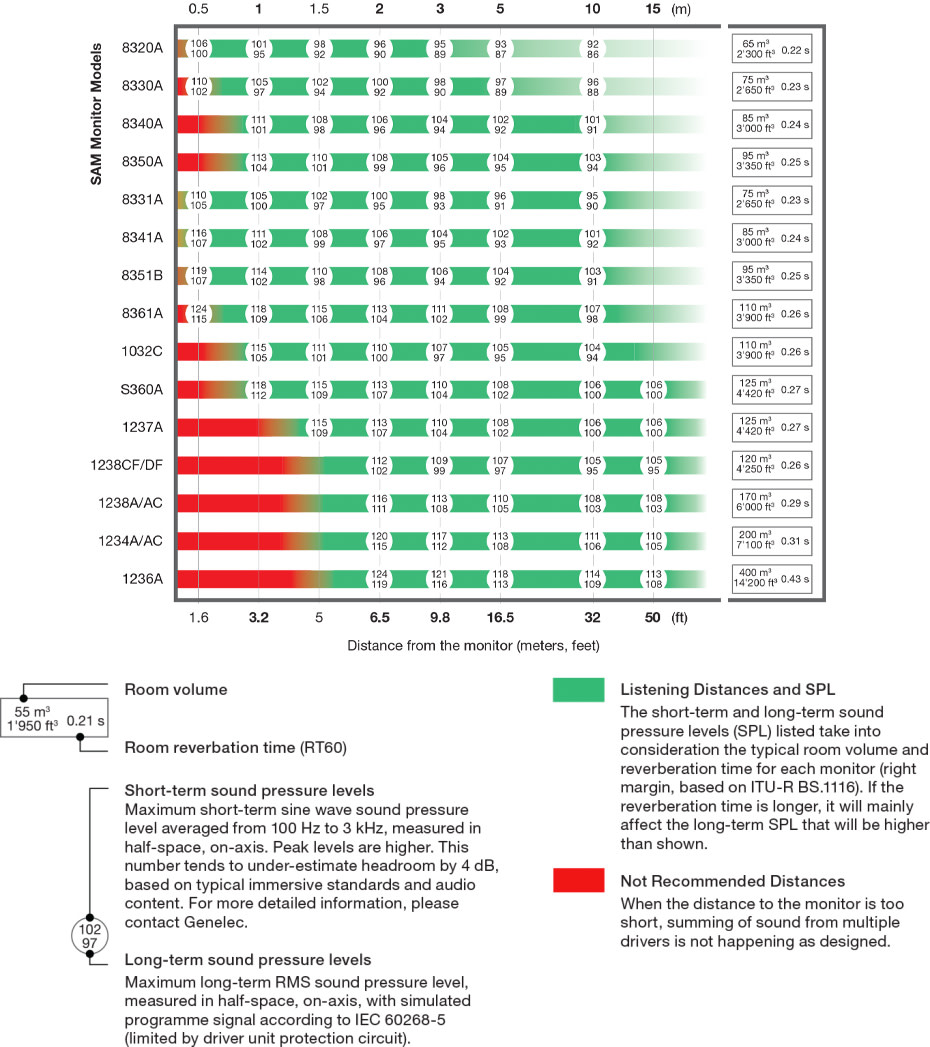
From Genelec
https://www.genelec.com/correct-monitors
Sound Basics
Sound is ultimately pressure which exists in a sequence of waves which propagates through compressible media such as air or water. Sound travels approximately 344 m/s (1130 ft/s). It takes 3 ms for sound to travel 1 metre (3,3 ft).
In free-field conditions (no walls, floor, or ceiling) the sound volume drops 6 dB when the distance doubles.
| Distance | Sound Level | Volume Drop |
|---|---|---|
| 1 m | 100 dB | 0 dB |
| 2 m | 94 dB | -6 dB |
| 4 m | 88 dB | -12 dB |
Sound level increases by 3 dB when the amplifier power doubles.
| Amp Power | Sound Level | Volume Increase |
|---|---|---|
| 100 W | 85 dB | 0 dB |
| 200 W | 88 dB | +3 dB |
| 400 W | 91 dB | +6 dB |
The industry standard reference sound pressure level (SPL) for cinema and TV sound production work is between 82 and 85 dB at the listening position.
Frequency Spectrum
The frequency spectrum of an electrical signal is, by definition of Collins online dictionary, “the distribution of the amplitudes and phases of each frequency component against frequency”. The audible frequency spectrum covers 10 octaves (up to 40 Hz, 80, 160, 320, 640, 1’280, 2’560, 5’120, 10’240, 20’480 Hz) which can conveniently divide the spectrum as follows.
| Subsonic bass frequencies | below 16 Hz | Not audible for humans. |
|---|---|---|
| Very low frequencies | 16 – 40 Hz 40 – 80 Hz | Lowest audible octave for humans. Music low frequencies, kick drums, bass instruments |
| Low frequencies | 80 – 160 Hz 160 – 320 Hz | Low register of a grand piano. Middle C of a piano. |
| Midrange frequencies | 320 – 1,280 Hz | Music midrange frequencies |
| Upper midrange frequencies | 1,280 – 2,560 Hz 2,560 – 5,120 Hz | Low-order harmonics of most instruments. The ear is the most sensitive in this range. |
| High frequencies | 5,120 – 10,240 Hz | Brightness and harmonics |
| Extremely high frequencies | 10,240 – 20,480 Hz | Highest harmonics. Inaudible to humans above 20 kHz |